by Gail Broome
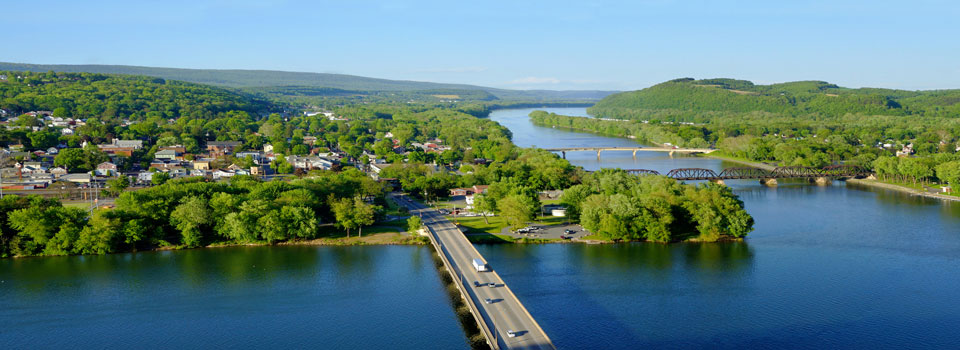
Three years after the 1791 "Church and King" rioters destroyed Joseph Priestley's home and church in Birmingham, England, he removed to America and settled in Northumberland, Pennsylvania, a small town approximately 150 miles northwest of Philadelphia. His son, Joseph, Jr., had already set up residence there in anticipation of forming a pantisocratic community, based on religious and political freedom, nearby. Although the Priestley family and others purchased land towards this end, the plans for it fell through. The Priestleys, however, remained in Northumberland and Rev. Priestley resumed the works that had earned him such note in England.
Despite his many accomplishments as scientist, educator and theologian, Priestley, according to his son, "...considered the office of a Christian minister as the most useful and honourable of any, and had always derived the greatest satisfaction from fulfilling its duties, particularly from catechizing young persons..."
His new American home, therefore, for some time proved a disappointment to him in that respect. Although he wrote about holding weekly home services for a small number of persons as early as the autumn of 1794, it would be years before he would be satisfied that he had established a true Unitarian congregation in Northumberland. In an early letter to Reverend Thomas Belsham, Priestley mentioned that he found there "nothing but the extremes of infidelity and bigoted orthodoxy." Nonetheless, it might still be said that some of the earliest Unitarian worship services in America were held in Northumberland.
Writing to Theophilus Lindsey in September of 1794, Priestley referred to preaching, by invitation, at a Presbyterian meeting house. As he put it, "...but though I am sure I said nothing which could give any Christian just offence, they never asked me again." A Mr. Bakewell, a local resident, commented that one of the Presbyterian ministers threatened that "...he would never enter the pulpit again" if Priestley were allowed back. Priestley also told of preaching, at the request of their officer, to a company of soldiers, as well as to some locals. Throughout various correspondence of 1794, Priestley mentioned conducting a service every Sunday at his son's home and, also, reading a sermon in his own house. In addition to family, local residents, primarily other English emigrants, were in attendance although their numbers were evidently quite small.
For a time, in late 1794 and early 1795, he was under the impression that locals, "...all the more intelligent people in the place," would be having a church constructed for him. This never happened. While he anticipated eventually holding worship in the common hall of a college which was to be built, he contented himself with home services. The college, Northumberland Academy, was not constructed until 1803.
Mr. Bakewell, mentioned previously, described services conducted by Priestley that he attended during the summer of 1795. "His discourses were usually practical, easy to understand, and reducible to common life. In his prayers he was devout, and free from the error which many fell into, of multiplying words, when addressing the Divine Being, as though he wanted information."
Also in the summer of 1795, Priestley preached at Sunbury, a neighboring town, at the behest of "...judges of the Supreme Court." He had a "...tolerable audience, some of whom...were much surprised to find that I was a Christian."
While continuing to hold his home services, Priestley concentrated on his writing as a vehicle for spreading information on his beliefs. He also traveled to Philadelphia several times where he would preach to the Society of Unitarian Christians of Philadelphia. It was in 1796 that Priestley gave a series of sermons in Philadelphia, which were held at the Universalist Meeting House. In America, where Unitarians and Universalists only merged in 1961, it is interesting to note the early fellowship between the two groups. The Philadelphia Society was formally organized on June 12, 1796.
As late as 1798, Priestley reported to friends little success in growth for his small group of Unitarian worshippers, "...though the place contains many persons of good sense, and the preachers are nothing better that the common run of Methodists in England."
The year 1799 saw the publication of Priestley's Letters to the Inhabitants of Northumberland and Its Neighbourhood, on Subjects Interesting to the Author and Them, within which he outlined his views on various subjects. In the letter on religion, he tells the local residents that "...had I been permitted to officiate in either of your meeting houses...., you would never have heard from me anything but the principles of our common Christianity."
Priestley felt that this writing improved the perception of him by the area populace and was the turning point in his establishment of a relatively sizable group of Unitarian worshippers in Northumberland.
Hugh Bellas, Esquire, who as a young man received much encouragement and attention from Priestley, described services held in a log school house in 1799 for a congregation ranging from 15 or 20 individuals and more..."He administered the Lord's Supper, handing the bread and wine to his little grandchildren, as well as to any other who chose to partake. A person to whom he gave the elements carried them round to those present who were seated. On at least some of these occasions he was much moved--the tears ran down his cheeks, and his voice struggled for utterance."
Bellas also mentions Priestley's lectures to a class of young men, consisting primarily of mechanics. Priestley referred to this class as "confirmed Unitarians."
It was only his final illness prior to death that could stop Priestley's actions as a Unitarian minister. It was the first time he was not able to conduct the services that were such an important part of his life. He died February 6, 1804, leaving behind a Unitarian legacy in Northumberland, which, despite great ebbs and flows for nearly two centuries, remains to this day.
Dr. Priestley, his beloved wife, Mary, and other members of the Priestley family are buried in a small Northumberland cemetery. The home Priestley had built and resided in is now a museum owned by the Pennsylvania Historic and Museum Commission.